To select the best 3D printer filament in 2026, evaluate demands like strength, heat tolerance, flexibility, and appearance. Beginners benefit from PLA filaments, while functional projects require durable PETG, high-temp ABS, or flexible TPU.
Matching project goals with material specifications guarantees reliable 3D printing results. SUNLU products such as PLA, PETG, and TPU list a 1.75 ± 0.02 mm diameter tolerance and controlled spool winding, which can support more consistent filament feeding.
Understanding material properties enables operators to choose the ideal 3D printing filament for every additive manufacturing application.
Direct Summary of Key Selection Criteria
Evaluating performance metrics helps determine the proper material for specific project requirements across prototyping and production.
Beginner & Visual Models: High-quality PLA filaments from SUNLU offer effortless printing, low shrinkage, and smooth surface finishes.
Functional & Outdoor Parts: SUNLU PETG delivers exceptional impact resistance, weather durability, and chemical tolerance for functional components.
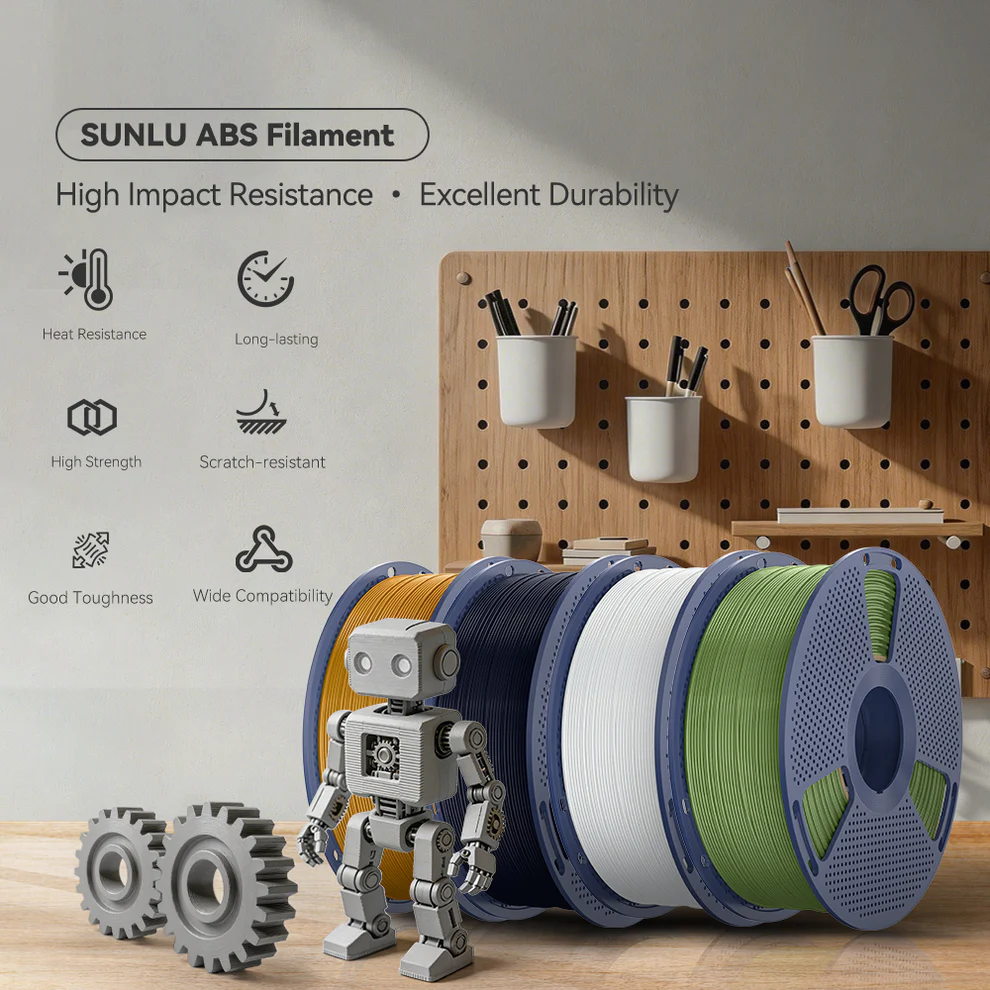
Engineering & Flexible Parts: SUNLU ABS provides high heat resistance, while flexible TPU enables durable, rubber-like prototypes.
Understanding Basic Thermoplastic Filament Categories
Selecting suitable materials begins with understanding fundamental polymer classifications. Every 3D printing filament formulation serves specific mechanical and environmental demands during production.
Standard PLA filaments remain the default choice for general visual prototyping. They feature excellent dimensional stability, minimal warping, and low processing temperatures between 190°C and 220°C.
For enhanced impact resistance, SUNLU PLA+ delivers superior toughness over standard formulas. Additionally, high-speed PLA options accommodate rapid extrusion rates on modern 3D printers.
Selecting properly engineered 3D printer filament prevents layer separation and minimizes material waste across production workflows.
Comparing Strength and Durability for Functional Components
Functional parts subject to physical stress require materials with high mechanical integrity. Standard PLA filaments may deform under heavy structural loads or elevated operating temperatures.
When mechanical durability is essential, SUNLU PETG provides an ideal balance of flexural strength and toughness. It combines relatively easy printing with good toughness and resistance to a range of common environmental conditions.
SUNLU PETG recommends nozzle temperatures of about 230–260°C and a heated bed around 60–70°C, depending on printing speed and setup. These settings can support layer adhesion, while retraction, moisture, and temperature adjustments may still be needed to control stringing.
For high-temperature applications, SUNLU ABS withstands thermal deflection up to 84°C. However, ABS requires enclosed print chambers to prevent warping caused by rapid cooling.
Exploring Specialty Materials for Unique Technical Needs
Beyond standard thermoplastics, specialized formulations expand technical capabilities in additive manufacturing. SUNLU TPU allows operators to produce elastic components like gaskets, seals, and protective bumpers.
Flexible TPU requires controlled extrusion speeds and product-specific nozzle temperatures; for example, SUNLU TPU 90A is listed at 220–240°C, while TPU 95A uses different ranges depending on printing speed. Controlled feed rates prevent flexible material from binding inside direct-drive extruders.
For decorative models, SUNLU Silk PLA creates vibrant metallic finishes without post-processing. Options like Marble and Wood PLA add unique visual textures to architectural concepts.
For maximum structural stiffness, carbon fiber reinforced blends deliver high strength-to-weight ratios. These technical materials minimize part flex while maintaining dimensional accuracy under load.
Quality Metrics: Ensuring Printing Reliability and Precision
Material consistency directly impacts print quality and operational efficiency. Subpar spools with inconsistent diameters cause uneven extrusion, severe nozzle clogs, and surface blemishes.
High-quality 3D printer filament adheres to strict dimensional tolerances within ±0.02mm. Precision diameter control guarantees predictable volumetric flow through standard 1.75mm hotends.
SUNLU utilizes advanced manufacturing controls to maintain consistent resin purity. This strict tolerance ensures full compatibility with mainstream FDM machines, including Bambu Lab and Creality systems.
Furthermore, orderly spool winding prevents dangerous tangles during unattended operation. Proper spool winding can reduce tangling and help maintain more consistent filament feeding during long prints.
Optimizing Printer Settings for Different Polymers
Achieving flawless results requires matching printer parameters to your chosen polymer. Hotend temperatures, bed heating, and cooling fan speeds must align with verified material specifications.
Standard PLA filaments operate efficiently with print bed temperatures between 50°C and 60°C. Part cooling fans should run at full capacity to preserve sharp overhangs and intricate geometric details.
In contrast, SUNLU PETG and ABS require reduced fan speeds to maximize thermal layer bonding. Disabling part cooling on initial layers prevents corner lifting and bed detachment.
Using dry filament remains important for moisture-sensitive materials such as PETG and TPU. Storing spools in sealed dry boxes maintains original polymer properties over extended storage periods.
Practical Recommendations for Project-Specific Selection
For everyday visual models, choose entry-level PLA filaments due to their user-friendly handling and wide color selection. They provide an economical solution for fast visual prototyping.
For functional enclosures exposed to humidity or mild chemicals, select SUNLU PETG. Its combination of flexural strength and weather resistance suits both indoor and outdoor environments.
When building heat-resistant tools, select ABS or specialized technical blends. Ensure your equipment includes a heated bed reaching 80°C to 100°C for secure bed adhesion.
Sourcing high-grade 3D printing filament ensures reliable thermal performance and consistent structural results across all additive projects.
Balancing Performance, Reliability, and Material Properties
Selecting the right 3D printer filament involves balancing mechanical strength, thermal tolerance, flexibility, and ease of use. Aligning these factors with specific project demands can improve print consistency and reduce material-related failures.
Utilizing precisely manufactured spools prevents costly print failures, nozzle blockages, and material loss. Consistently calibrated options from SUNLU maintain strict diameter control, protecting equipment while delivering refined surface finishes.
Whether manufacturing flexible industrial gaskets, durable protective housings, or detailed display prototypes, selecting verified thermoplastics elevates overall output quality. Thorough material evaluation empowers makers and engineers to achieve optimal performance across every project.
