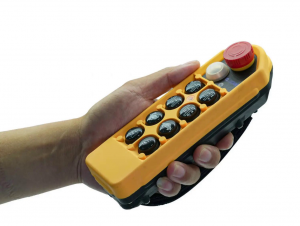
Designing an intrinsically safe control for a hazardous area isn’t a matter of taking a standard transmitter and adding a tougher shell. Every material, connector, and internal circuit has to be reconsidered through the lens of ignition risk. A handheld unit that’s perfectly safe in a normal factory can become a genuine hazard in an environment where flammable gas or dust is present. Understanding what actually goes into an explosion-proof design helps explain why these units differ so much from standard industrial transmitters, even when they look similar from the outside.
Material Selection Comes First
The housing material is an important consideration in the design of equipment intended for hazardous environments. Unlike standard industrial transmitters, intrinsically safe equipment may require flame-retardant and conductive materials to address both fire-related risks and electrostatic charge accumulation. Techwell’s FYF100A uses flame-retardant conductive engineering plastics, a material choice relevant to controlling static buildup and meeting the requirements of its explosion-protection design. Material selection is only one part of the overall safety approach, however. The housing, internal components, electrical design, and certified configuration must work together to meet the applicable explosion-protection requirements.
Certification Defines the Engineering Boundaries
The design of an intrinsically safe transmitter is subject to the requirements of its applicable explosion-protection certification. The FYF100A is identified with the Ex ia IIC T4 Ga marking and is designed in accordance with China’s GB/T 3836.1-2021 and GB/T 3836.4-2021 standards, covering general requirements for equipment used in explosive atmospheres and intrinsic safety protection. Intrinsic safety focuses on limiting the electrical energy within a device so that ignition risks are controlled under the specified operating and fault conditions.
These requirements influence several design decisions, including battery selection, circuit protection, component specifications, and internal layout. Buyers should therefore evaluate the complete certified configuration rather than treating the transmitter’s individual components or optional features as independently interchangeable. Any modification or customization should be reviewed against the applicable certification requirements before being adopted.
Weight and Size Still Matter for Field Use
A transmitter used in industrial environments needs to balance its protective structure with practical handling requirements. The FYF100A weighs 1.2 kg excluding the battery and measures 265 × 171 × 172 mm. These dimensions provide a reference for assessing its physical size and weight during equipment selection. Its relatively compact and lightweight construction may be relevant when comparing transmitter options for applications involving regular manual operation. Actual handling suitability should still be assessed according to the mounting method, operating posture, battery configuration, and duration of use.
Control Layout Needs to Balance Function and Safety Requirements
An explosion proof handheld remote control must provide the control functions required by the machinery while remaining within the limits of its certified design. The appropriate layout depends on the equipment’s operating logic and the type of commands the operator needs to send.
For applications requiring proportional motion control, selecting a transmitter with proportional joysticks is only part of the process. The receiver must also support the corresponding proportional output method and be compatible with the machine’s control system. A proportional joystick transmitter paired with a receiver designed only for on/off relay commands would not provide the intended proportional control. Techwell’s OEM customization can be considered when defining button arrangements and control functions, but the final hardware and configuration must remain consistent with the applicable explosion-protection certification.
Power Supply Design Under Intrinsic Safety Limits
Battery selection for intrinsically safe equipment involves more than operating capacity. The battery must be suitable for the hazardous-area application and compatible with the transmitter’s certified electrical configuration. For mining operations, the FYF100A should be paired with an appropriate explosion-proof battery option, such as Techwell’s BL5, where specified for the intended equipment configuration. Buyers should confirm the battery model, electrical parameters, compatibility, and applicable certification before use.
Battery replacement and charging procedures also need to follow the requirements for the relevant hazardous-area classification. A battery should not be assumed suitable for an explosion-protected transmitter simply because its voltage and connector appear compatible.
Signal Reliability in Confined or Obstructed Spaces
Mining tunnels, processing facilities, and other industrial sites can contain physical obstructions and multiple sources of radio-frequency activity. The FYF100A’s listed frequency bands include 433 MHz (427.000–436.300 MHz) and 470 MHz (472.350–485.775 MHz), with a stated wireless range of at least 150 meters and a built-in antenna. These specifications provide reference points when assessing frequency configuration and communication coverage for a particular installation.
Dual-band capability offers additional frequency-selection options, but it does not by itself establish that communication will remain uninterrupted in every underground or obstructed environment. Actual performance depends on the site layout, surrounding structures, radio interference, antenna arrangement, and the compatible receiver configuration. A site-specific assessment is therefore important when determining whether the selected system can cover the intended operating area. This is particularly relevant when specifying a remote control for mining equipment, where transmitter, receiver, and environmental requirements need to be considered together.
Optional Features Within Certified Limits
Optional functions should be selected according to the machinery’s actual operating requirements and the available certified configurations. Display modules, identification functions, sensors, and other additional features may affect the transmitter’s internal design and electrical configuration. Their availability should therefore be confirmed for the specific explosion-protected model rather than assumed to be compatible with every version.
For buyers evaluating optional features, the key consideration is whether the requested configuration has been reviewed and approved within the applicable certification framework. Customization should not be treated as permission to add components or modify circuits beyond the certified design.
Environmental Durability Remains a Configuration Requirement
Environmental protection requirements vary according to where the transmitter will be used. For outdoor installations exposed to dust, water, and changing weather conditions, an IP66-rated configuration may be appropriate, provided that this rating is confirmed for the specific model and certified version being supplied. Temperature and humidity limits should likewise be checked against the relevant product specifications.
For mining and other hazardous-area applications, environmental protection is only one part of the selection process. The explosion-protection marking, battery configuration, operating temperature, and compatibility with the intended receiver must also be verified. Rather than assuming that one transmitter configuration covers every industrial environment, buyers should specify the actual site conditions and select the corresponding certified equipment combination.
Conclusion
Designing an explosion-proof handheld remote control involves layering several engineering considerations at once: conductive, flame-retardant materials, intrinsic safety certification, a workable ergonomic form factor, a power supply constrained by safety thresholds, and reliable signal performance in confined spaces. Techwell Remote Control applies this approach in models like the FYF100A, which combines Ex ia IIC T4 Ga certification with a control layout configured for its intended hazardous-area applications.
