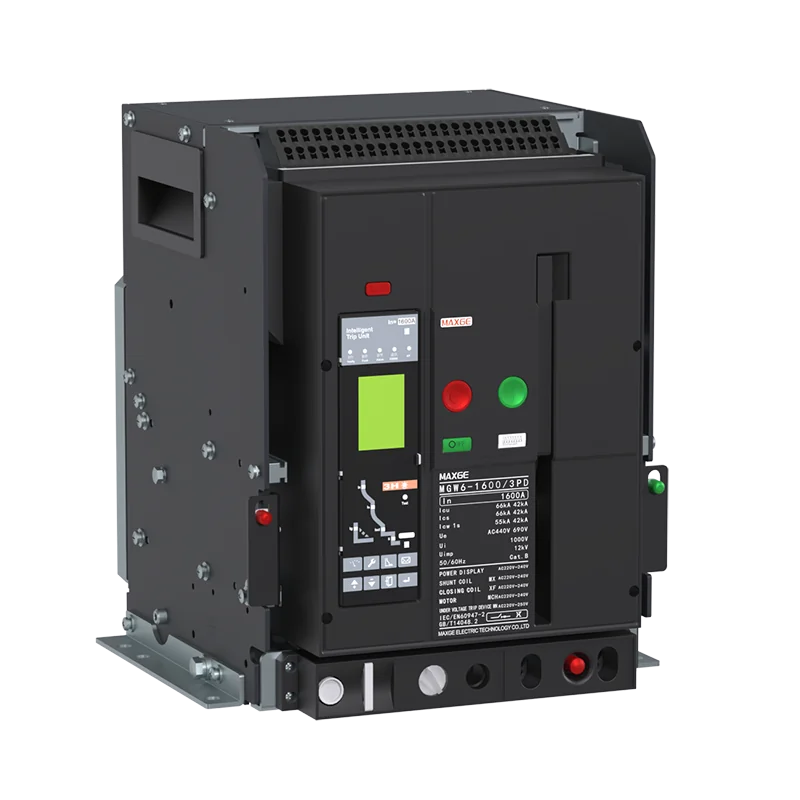
As electrical loads continue to increase in industrial facilities, commercial complexes, power distribution rooms, and infrastructure projects, reliable protection at the main distribution level becomes increasingly important. Selecting suitable electrical control products is not simply about choosing a device with a high current rating. Engineers and procurement teams also need to consider fault protection, selectivity, maintenance, installation, and long-term operating requirements.
An air circuit breaker is commonly used in these high-current applications because it is designed to handle large electrical loads while providing controlled interruption during abnormal conditions. Understanding how an ACB works and where it fits within a protection system can help users make more practical equipment decisions.
What Is Air Circuit Breaker Technology?
For those asking, “What is an air circuit breaker?” an air circuit breaker, or ACB, is a frame-structured circuit protection device designed for high-current, low-voltage distribution systems. Unlike breakers that use other arc extinguishing media, an ACB uses air to extinguish the arc generated when the circuit is interrupted.
The main purpose is to disconnect the power supply when conditions such as overload or short circuit faults occur. Its relatively high current capacity makes it suitable for main distribution sections where conventional miniature circuit breakers may not provide sufficient protection.
An ACB can also support protection coordination within a larger electrical system. When properly selected and configured, it can help isolate a fault while reducing unnecessary interruption to unaffected circuits.
Why High Current Facilities Need Appropriate Protection
High current facilities often contain equipment with substantial and continuous electrical demand. Manufacturing lines, power distribution systems, commercial buildings, data-related infrastructure, and large mechanical systems can place significant loads on incoming and main distribution circuits.
A protection device in these locations needs to do more than interrupt current. It must respond appropriately to fault conditions while fitting the electrical characteristics of the installation. Incorrect selection may result in insufficient protection, unwanted tripping, difficult maintenance, or poor coordination between upstream and downstream devices.
This is why electrical control products should be evaluated as part of the complete distribution system rather than as isolated components. Current rating, breaking capacity, protection settings, installation method, operating environment, and coordination requirements all deserve attention during the selection process.
Understanding Air Circuit Breaker Application
The air circuit breaker application is generally associated with high-current main distribution and large-capacity electrical systems. Typical installations can include power plants, substations, industrial facilities, and commercial complexes. MAXGE’s product range includes ACB models such as MGW6-3200, MGW6-4000, MGW6-6300, and MGW6-7500, providing options for different high-current distribution requirements.
In a typical distribution system, an ACB may be installed at the incoming side of a switchboard or at a major outgoing circuit. Its position allows it to provide protection for important sections of the electrical network and help separate faults from the wider system.
The actual application should always be determined according to system voltage, rated current, prospective fault current, protection coordination, installation conditions, and applicable standards. A technically suitable device should match the complete electrical design rather than being selected solely according to its maximum current rating.
Choosing Between Different Air Circuit Breaker Types
When comparing air circuit breaker types, users may encounter different configurations designed for different installation and operating requirements. The appropriate configuration depends on factors such as the distribution architecture, available cabinet space, maintenance procedures, and operational requirements.
Protection functions are another important consideration. High current distribution systems may require suitable settings for overload and short circuit protection, while more demanding installations may also require coordination with downstream protective devices.
Maintenance requirements should also be considered before purchasing. A breaker that can be inspected, operated, and maintained efficiently can contribute to easier service planning over the equipment’s operating life. MAXGE describes its ACB range as offering high-rated current, air arc extinction, strong breaking capability, fault clearing, selectivity protection, and modular maintenance characteristics.
How ACBs Fit Into Electrical Control Products
An ACB is only one part of a complete electrical protection and control system. Depending on the project, it may work alongside MCCBs, MCBs, RCCBs, RCBOs, contactors, distribution boxes, surge protective devices, and other industrial components.
The benefit of considering these electrical control products as a coordinated system is that each device can perform a defined role. An ACB can protect high-current main circuits, while downstream breakers can provide protection closer to individual loads. This layered approach can make fault management more structured and support continuity of operation.
For project engineers and purchasing teams, working with a supplier that offers multiple categories can also simplify product evaluation and system matching. MAXGE’s product portfolio includes MCB, RCD, and RCBO, MCCB, ACB, smart breakers, distribution boxes, and industrial devices, allowing different protection and control requirements to be considered within one product portfolio.
Selecting the Right ACB for Your Project
Before selecting an air circuit breaker, it is useful to establish the actual requirements of the electrical system. Rated current is an obvious starting point, but it should not be the only factor. Fault levels, voltage, number of poles, protection functions, installation arrangement, coordination requirements, and maintenance access should also be reviewed.
Technical documentation should then be checked carefully to confirm that the selected model corresponds with the project’s electrical parameters. For customized project requirements or questions about available models, discussing the application with a qualified technical team can help reduce selection errors.
Reliable Protection Starts With the Right Product Selection
High-current electrical systems require protection equipment that corresponds to the operating conditions and distribution architecture of the installation. An air circuit breaker can serve as an important protection and control device at the main distribution level, particularly in systems where higher current ratings, short-circuit interruption, and coordinated protection are required.
Selecting an ACB involves more than comparing rated current. Breaking capacity, voltage, trip unit functions, protection settings, installation configuration, and coordination with downstream devices can all influence the suitability of a particular product. MAXGE offers a broad low-voltage electrical portfolio covering circuit protection, distribution, and control, with applications extending to PV, renewable energy, energy storage, and EV charging systems.
Its product development and manufacturing capabilities are supported by R&D resources, automated production at its Deqing and Wuhu bases, patented technologies, software copyrights, CNAS-related laboratory capabilities, and international certifications. Through the MAXGE, EMA, and GEBLER brand portfolio, the company serves customers in more than 60 countries with support from over 80 distribution partners.
For ACB specifications, application requirements, or protection configuration questions, you can contact MAXGE through its official website to discuss suitable product options for your electrical system.
