Selecting the right dispensing valve starts with understanding how an adhesive flows, responds to pressure, and behaves after application. Material viscosity, filler content, curing characteristics, deposit geometry, and production speed all influence which valve technology will perform reliably.
Automated adhesive dispensing systems can support consistent application, but only when the dispensing mechanism matches the fluid and process requirements. Axxonauto operates in the precision dispensing sector, where material compatibility and practical process validation are essential to achieving repeatable results.
How to Match Valve Technology to Adhesive Rheology?
Viscosity provides a useful starting point, but it does not tell the whole story. Some adhesives flow readily under pressure, while others become less resistant to flow when subjected to shear. Temperature can also change viscosity, meaning a material that dispenses smoothly in a controlled laboratory environment may behave differently on a production floor.
Low-viscosity fluids often require careful control of flow rate and shutoff to prevent dripping, spreading, or excessive deposits. Higher-viscosity formulations may need greater dispensing force or a valve designed to handle thicker materials. Pressure alone is not a universal solution: excessive force can cause splashing, inconsistent bead geometry, or unwanted material discharge.
Adhesives containing abrasive fillers introduce another consideration. Particles can accelerate wear in narrow passages and moving components, especially during extended production runs. Valve selection should account for particle size, material compatibility, cleaning requirements, and expected service life rather than relying solely on the adhesive’s nominal viscosity.
| Valve type | Suitable material | Main limitation |
| Needle valve | General adhesives, controlled beads | Small passages may clog with curing or filled materials |
| Jetting valve | Low-to-medium viscosity, small dots | Requires stable fluid behavior and proper valve dynamics |
| Positive-displacement | Medium-to-high viscosity, repeatable dosing | Calibration and maintenance demand |
How to Choose a Dispensing Mechanism for the Application?
Needle valves are commonly used for controlled deposits of compatible fluids, particularly where contact dispensing and straightforward flow adjustment are suitable. Their performance depends on needle geometry, fluid properties, pressure stability, and the distance between the outlet and the target surface. Small passages can become difficult to maintain when materials cure quickly or contain particles.
Jetting valves release controlled droplets without requiring the dispensing nozzle to touch the substrate. This can be useful for closely spaced components, irregular surfaces, and applications where contact with delicate assemblies is undesirable. However, jetting performance depends on fluid behavior, droplet requirements, valve dynamics, and the operating window supported by the selected system.
Other mechanisms, including screw-based and positive-displacement designs, may suit materials that require controlled delivery or present challenges for conventional pressure-fed valves. The best option depends on whether the process prioritizes bead continuity, small-volume deposits, non-contact placement, or handling of demanding formulations. A controlled trial with the actual adhesive is more informative than assuming one valve type will work across every application.
How to Evaluate Process Stability and Operating Costs?
A valve may produce acceptable deposits during initial setup yet struggle to maintain consistency over a long production shift. Changes in material temperature, reservoir pressure, adhesive age, and environmental conditions can affect output. Stable operation requires a suitable combination of fluid preparation, pressure regulation, timing, and maintenance practices.
Cycle time also influences the decision. Dispensing equipment involving thousands of small deposits may benefit from a high-speed jetting approach, while a continuous sealing bead may place greater importance on uninterrupted flow and accurate shutoff. Engineers should evaluate the complete dispensing sequence, including movement between targets, material replenishment, cleaning, and inspection.
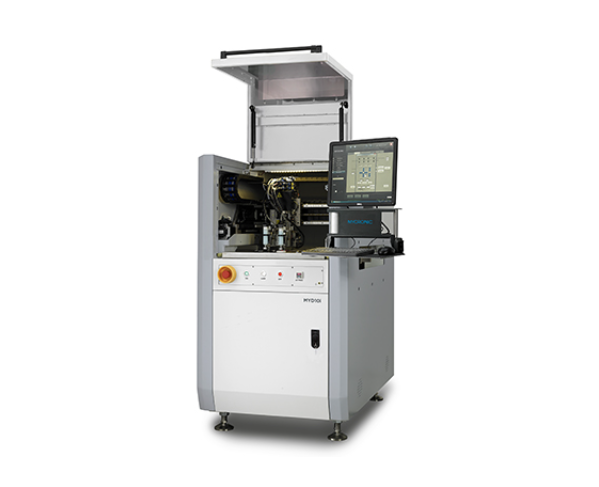
The MYD10i is part of the MYD series and is described as a cost-efficient dispensing solution with compact machine dimensions and a streamlined mechanical design. Its stated features include piezo jetting technology with fewer wear parts, intended to reduce maintenance demands and downtime. This example illustrates why valve technology and machine architecture should be considered together; suitability still depends on the adhesive, required deposit, and validated process conditions.
How to Validate Material Compatibility Before Production?
A valve specification sheet cannot fully predict how an adhesive will behave in a real application. Before approval, testing should use the intended formulation, substrate, and production settings. Useful observations include deposit volume, shape, placement accuracy, stringing, dripping, clogging, and consistency over repeated cycles.
Material compatibility deserves particular attention when adhesives contain solvents, reactive ingredients, or abrasive particles. Wetted components must tolerate the fluid without corrosion, swelling, contamination, or premature degradation. Cleaning agents also need to be compatible with both the adhesive and valve materials, especially when switching between formulations.
Maintenance planning should be established during validation rather than after the first production problem. Manufacturers can record cleaning intervals, inspect wear-prone components, and define acceptable limits for changes in deposit quality. This information helps distinguish normal servicing needs from a mismatch between the selected valve and the material.
Conclusion
Valve selection is a process-engineering decision, not simply a comparison of dispensing speed or purchase price. The adhesive’s flow behavior, deposit geometry, substrate sensitivity, production volume, and maintenance demands must all be evaluated together.
Axxonauto operates in a field where precision fluid control supports increasingly varied manufacturing applications, yet the most appropriate solution depends on evidence from the specific process. Careful testing before production can reduce avoidable rework and help manufacturers establish reliable operating conditions.
FAQs
Which Valve Type Is Suitable for High-Viscosity Adhesives?
The answer depends on the formulation and required deposit. Some high-viscosity materials may suit screw-based or positive-displacement mechanisms, while other applications can use pressure-fed valves. Testing is needed to assess flow stability and deposit quality.
Can One Valve Handle Different Adhesive Materials?
Sometimes, but material changes may require different pressure settings, temperatures, dispensing parameters, or cleaning procedures. Differences in viscosity, filler content, and curing behavior can limit compatibility, so each intended material should be validated.
Why Does an Adhesive Drip After Dispensing?
Dripping can result from residual pressure, unsuitable shutoff behavior, low viscosity, temperature changes, or valve wear. Reviewing pressure regulation, valve settings, and fluid conditions can help identify the underlying cause.
