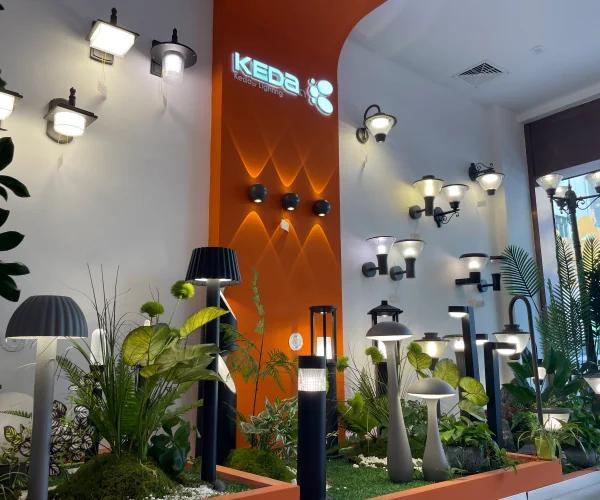
When designing or supplying outdoor equipment, commercial buyers and distributors often encounter an old problem: the environment deteriorates too quickly. Rain, large temperature fluctuations, and humidity constantly affect the functionality of outdoor equipment. To cope with these rather unfriendly conditions, the global market has already made significant changes in material selection. Leading brands like Keyida have gradually abandoned easily damaged plastic and cheap thin metal sheets and instead rely on sturdy die-cast aluminum.
For hardware store retailers and specialty lighting shops, it is quite important to understand these changes in materials. It is not only about aesthetics, but also about whether the product withstands time while maintaining an upscale visual appearance. As long as a company selects the appropriate materials, it can significantly reduce return rates and increase customer satisfaction. In this way, it can also gradually build long-term trust relationships in the highly competitive B2B market.
Engineering Advantages of Die-Cast Alloys
The unique mechanical properties of die-cast aluminum make it the undisputed choice for modern architectural designs. First, the material offers exceptional thermal conductivity. LEDs naturally generate substantial heat at the junction point, and if this heat is not dissipated efficiently, the lifespan of the light source drops dramatically. Aluminum alloys act as highly efficient heat sinks, drawing warmth away from the delicate internal electronics and outer casing, maintaining safe operating temperatures even in hot climates.
Furthermore, professional outdoor landscape lighting manufacturers leverage die-casting to achieve unparalleled structural precision and component integrity. Unlike fabricated sheet metal, which requires complex bending, cutting, and welding, liquid aluminum is forced under high pressure into custom-engineered steel molds. This advanced high-pressure process creates a single, seamless, and incredibly dense lamp frame. There are no weak welded joints to rust, crack, or leak over time. For high-volume retailers, this structural integrity translates directly to zero shipping damages and fewer customer complaints. The dense structure also enables the creation of compact, modern silhouettes with thin walls that remain remarkably strong and resistant to physical impacts in demanding public spaces.
Precision Surface Finish and Unmatched Waterproofing
Raw durability is only half the battle; outdoor fixtures must also look premium on the retail shelf and on the architectural wall. Die-cast aluminum provides an excellent substrate for high-quality protective surface treatments. High-end products undergo a rigorous process of professional re-polishing and precision spray painting. This dual-step treatment ensures the metal surface is completely smooth, allowing the powder coating to adhere flawlessly without bubbling, chipping, or flaking.
This meticulous finish is a core reason why professional buyers trust premium manufacturing. For instance, while a standard factory might offer a basic paint job, top-tier factories ensure their coatings are UV-resistant and anti-corrosive. This prevents the peeling and fading commonly caused by intense sunlight and salt spray in coastal regions. Combined with premium PC or acrylic lamp shades, these aluminum bodies achieve superior waterproof performance. Although many commercial buyers look for standard three-year warranties, high-quality die-cast fixtures are engineered to work reliably for five to six years. For retail distributors, stocking products with this level of build quality means fewer warranty claims and a stronger brand reputation among local contractors, commercial installers, and electricians.
